
The $10,000 Mistake Most Restaurants Don’t See Coming: A Connected Monitoring Framework
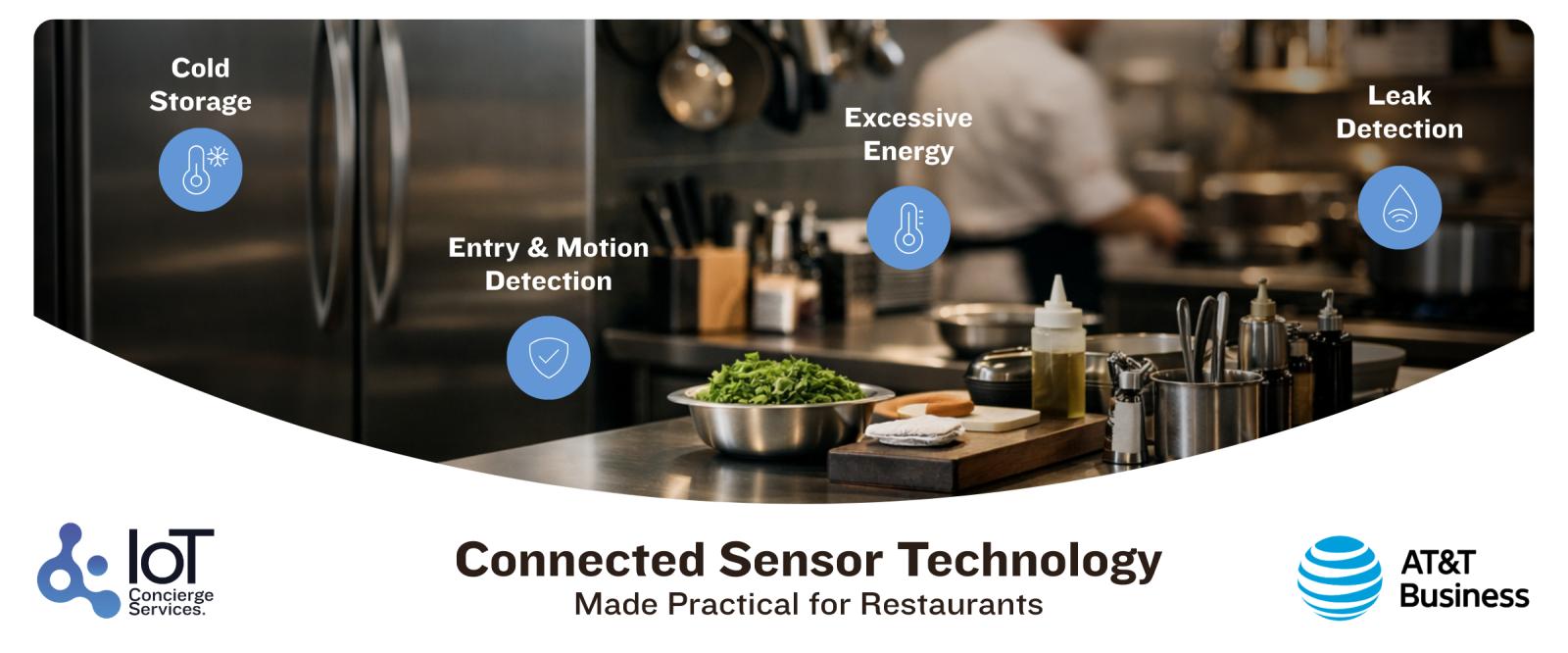
The $10,000 Mistake Most Restaurants Don’t See Coming:
A Connected Monitoring Framework
At 1:42 a.m., no one is thinking about your walk-in.
That’s exactly when the risk begins.
A small compressor hiccup.
A freezer door not fully sealed after deliveries.
A gradual temperature drift no one notices.
By morning, thousands of dollars in inventory can be lost — along with brunch revenue, staff morale, and potentially your reputation.
Most restaurants don’t suffer catastrophic operational failures. They suffer invisible ones.
And in today’s margin environment, invisible losses are unacceptable.
Why This Matters Now
Restaurant operators are navigating:
-
Volatile food costs
-
Labor shortages and staff turnover
-
Heightened inspection scrutiny
-
Rising insurance expectations
-
Multi-unit complexity
Small operational blind spots compound faster than ever.
The issue is not whether risk exists.
The issue is whether it is continuously monitored.
Connected monitoring — through AT&T Connected Spaces — is designed to reduce those blind spots. IoT Concierge Services serves as an authorized education and implementation partner within AT&T’s restaurant technology program, helping operators assess risk and structure deployment.
But before technology, there must be a framework.
The 5 Hidden Risks Quietly Draining Profit
1. Overnight Drifts
Small temperature deviations can destroy thousands in product before the first manager clocks in.
Without real-time alerts, you are relying on luck.
2. The “Looks Fine” Fallacy
Display temperatures are not product temperatures.
Without independent sensing inside product zones, operators miss real exposure.
3. Paper Log Gaps
Incomplete, pencil-whipped, or misplaced logs invite violations and liability.
Paper systems fail under staff turnover.
4. Power & Connectivity Blind Spots
If alerts fail when Wi-Fi or power drops, you don’t have monitoring — you have false security.
5. Escalation Failure
An alert sent to one inbox at 2:00 a.m. is not a response plan.
Without tiered escalation (on-duty → manager → owner), near-misses become losses.
The Prevention Stack: The Right Order of Protection
Connected monitoring only works when implemented correctly.
Step 1: Instrument Correctly
Independent sensors placed inside product zones — not just controller vents.
Step 2: Set Tight Thresholds
Based on product risk, not generic manufacturer defaults.
Step 3: Real-Time Alerts with Escalation
SMS, voice, or app notifications that repeat and escalate until acknowledged.
Step 4: Door Analytics
Detect patterns that cause temperature creep (delivery propping, repeated access).
Step 5: Cellular & Battery Fallback
Alerts must function during outages.
Step 6: Document Corrective Actions
Photo capture and digital logging close the loop.
Step 7: Weekly Exception Review
Management reviews summaries to detect recurring issues before they escalate.
Prevention is not one device. It is a layered system.
Manual vs. Automated Monitoring: The Strategic Difference
|
Manual |
Automated |
|
Periodic checks |
24/7 minute-by-minute sensing |
|
Staff-dependent |
Automated alerts with escalation |
|
Paper logs |
Exportable digital audit records |
|
Human error |
Structured redundancy |
|
Reactive |
Proactive |
Manual systems assume perfection.
Automated systems assume reality.
30/60/90 Rollout Plan for Operators
Day 0–30: Pilot & Protect
-
Instrument 2–3 highest-risk units
-
Set thresholds
-
Confirm escalation paths
-
Train managers on acknowledge → correct → document
Day 31–60: Scale & Standardize
-
Expand to remaining units
-
Enable digital log assistance
-
Establish weekly exception review rhythm
Day 61–90: Optimize & Prove ROI
-
Tune thresholds
-
Export audit logs
-
Produce avoided-loss summary
-
Document time savings
Implementation Checklist (Print & Review)
-
Map every cold unit
-
Define safe ranges per unit
-
Assign escalation roles
-
Confirm cellular fallback
-
Standardize corrective actions
-
Identify Wi-Fi weak spots
-
Document weekly reviewer
If you cannot confidently check each box, your exposure is measurable.
Strategic Close
Restaurants don’t lose money because of dramatic failures.
They lose money because of silent ones.
Connected monitoring reduces surprise, lowers loss, improves audit readiness, and gives operators back mental bandwidth.
If you want a structured evaluation of your current exposure:
Download the Connected Monitoring Playbook or Take the Restaurant Risk Checkup
Education first. Infrastructure second. Prevention always.